
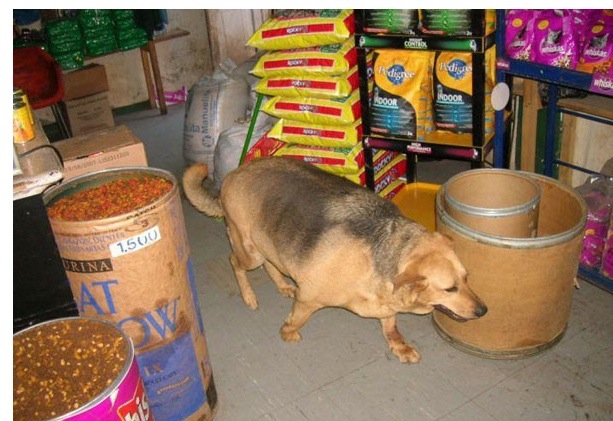
There are a number of reasons why it might be a good idea not to leave food out for a dog. Dogs, being scavengers and opportunists will eat whatever they can, whenever they can. They do not monitor their diets and can easily over eat. Eating problems that would never occur in the wild, occur in our pet dogs, because in the real world there is competition for food and more exercise. We might think that our pet dogs have a lovely and luxurious life, but often it is one of stress – because of a lack of exercise and stimulation. Just as humans do, dogs need to relieve boredom and often chewing is a result of this. If there is ad lib food, this is another reason for over indulging. States of anxiety might increase brain endorphins which in some way relate to the cause of obesity and over eating, as a form of comfort.
As Fogle outlines in his book, dogs “wolf down” their food because they are genetically programmed to do so and in a dog’s mind it is always “feast of famine” – their behaviour reflects this. When there is competition for food, the dog who eats fastest gets the most, this is something that has not been bred out of our pet dogs – so when food is left out, it is consumed.
In experiments “When rats were offered a ‘cafeteria’ of food, they showed considerable nutritional wisdom in selecting and consuming a nutritionally balanced diet. This might be true for rats but is not so for domestic dogs. Dogs will not wisely choose what is good for them…. Ake Hedhammar at the Swedish University of Agricultural Sciences in Uppsala noted in the early 1970’s that growing domestic dogs fed ad lib, simply overate and played less.” (Fogle – The Dog’s Mind)
Hormones released from the intestines along with glucose and various amino acids let the receptors in the hypothalamus know to give the dog signals that it is feeling full. This is apparently how most animals will maintain a normal body weight without having to do intensive workouts and monitor diet. However, we still have huge problems with our dogs and of course this is due to the “human element” as with most problems we see in animals. Humans have allowed those animals that would not have survived in the wild (due to their being too fat, lazy and slow) to continue to thrive and reproduce. There is now a “genetic predisposition to fatness” and this is worse, or more common, in some breeds than others: Labradors and Spaniels for example. It is therefore very important that we monitor a dog’s diet and this is not possible by leaving food down all the time and of course is impossible if we have more than one dog.
It is worth noting that aggression occurs when there is a higher serotonin level in animals – it is involved in the perception of food availability and social rank. Leaving food down all the time for a number of dogs could lead to a situation where competition, social rank and perception of food availability becomes a factor that leads to aggression.
In addition to this it can mean that dogs develop fussiness in their eating habits which can cause other problems for owners. One of the most important parts of feeding a dog is to make it part of a “feed time ritual” rather than letting the dog help itself whenever it wishes. This assists in the training and bonding process between human and dog.
Having a feeding ritual is a psychological challenge for the dog and offers the “discipline” part of training. The dog can be asked to perform a sit, or a sit stay for example and he can learn the command to “take” the food. The dog grows self esteem as he “earns” his food. This is why the Learn to Earn programme is so useful (Dr Sophia Yin’s programme, also the concept of “all or none” from Dr Ian Dunbar) and why I use it as part of all my foundations. It has multiple applications when used in conjunction with behaviour modification programmes.
A feeding ritual helps train patience and helps dogs learn not to take human food from human plates when coupled with other training and discipline around food. It is also possible during feeding time to help the dog understand that people can approach while the dog is eating and handle his food – showing him he does not need to be aggressive/possessive around it. It’s possible to teach “leave it” and then “take it” (back again) during a meal time – all important parts of the dog’s training, of good social behaviour and being a good canine citizen. When the dog was at the dump during its early development alongside humans, people and other dogs were milling around and dogs can eat quite happily with people and other dogs around. Problems can arise, even in dogs that behave perfectly well (even those that perform at extraordinarily high level in obedience classes) if they are left to feed alone – they become “unused” to people being around. Leaving food down for a dog to help itself, while an owner say, leaves for work, could create such an issue. Interestingly, feeding dogs in the presence of people and using things like hand feeding/learn to earn reduces the chances of aggression around food. Dogs fed alone are more frequently food possessive.

By feeding dogs individually owners can train calm and patience – asking their dog(s) to wait politely or at a distance while they prepare food. Whichever dog is calmest, sitting first or best, can eat first. Sometimes a feeding ritual whereby one dog is chosen to always go first to the feed bowl can create a consistency that reduces issues such as where sibling rivalry has given rise to aggression. This is a technique that can not be used if a dog is fed ad lib. I have used this method in the past, but these days, when using a bowl, prefer to allow the dog who is sitting first and calmest and most focused to “take it” first. This may mean that the same dog may not always be the one to go first. Also I like to use Learn to Earn so that dogs work for me and are not just competing with each other. This step is usually a significant one where dogs might be more possessive and reactive around each other when food is present.
Feeding individually also allows owners to train their dogs to their names – especially where there is more than one dog where it may be useful to an owner to have only one dog at a time to respond to a command. Feed time is the opportunity to give the name of the dog and the “take it” command – dogs soon learn to wait and listen for their name and the command they have to perform.
It might be good to consider that leaving food down all the time as not only lazy but a missed opportunity!